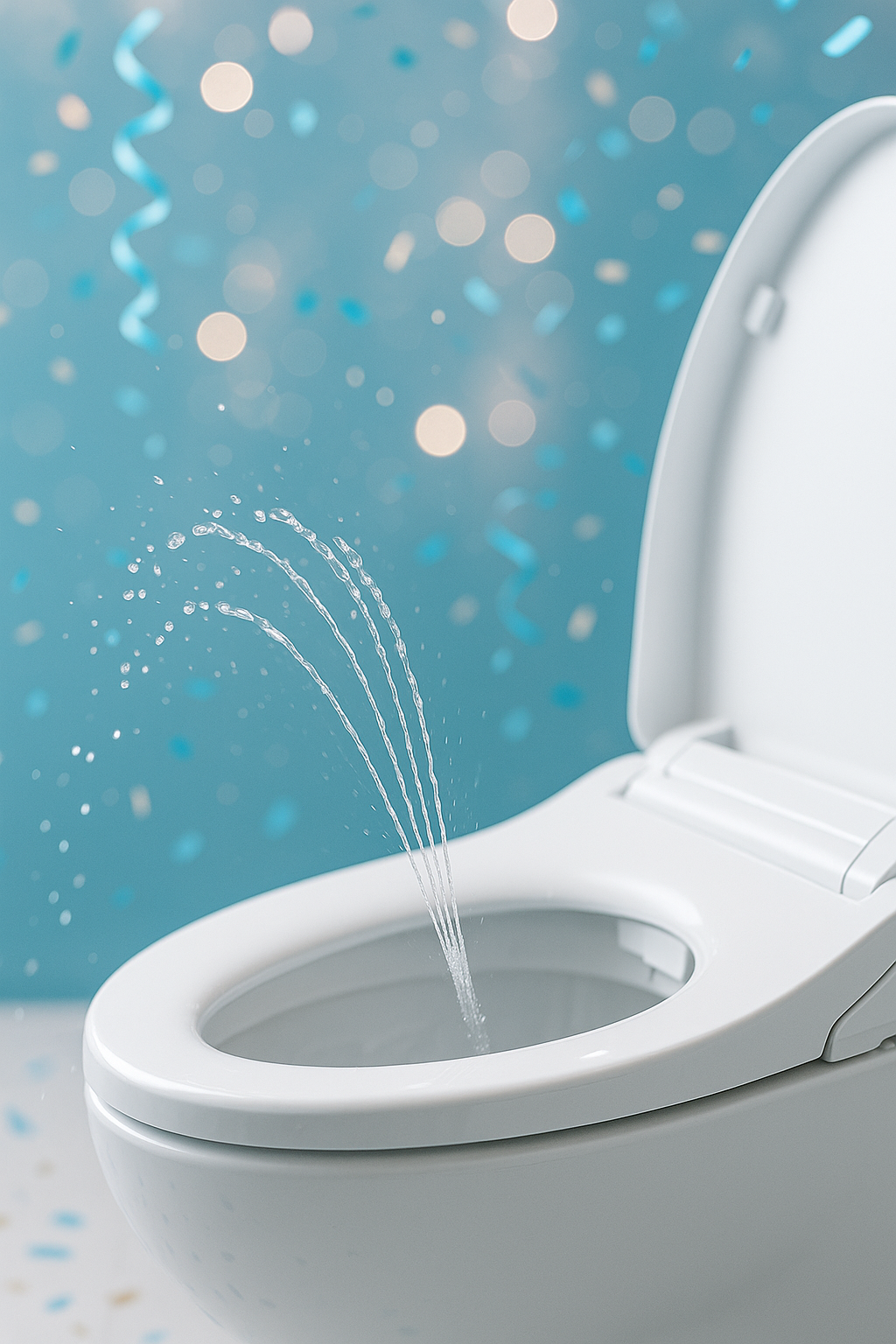
How much water does a bidet use?
Okay, so I'm the bidet guy, and this is the question I get the most: doesn't spraying yourself with water all day waste a ton of water? Fair worry. A bidet uses roughly 1/8th of a gallon (about 0.5 liters) of water per wash. That's the part people fixate on. The part they forget is that toilet paper, the stuff a bidet replaces, is itself basically made of water. A single roll takes an estimated 37 gallons to manufacture. So the "bidets waste water" instinct has the math backwards. You spend a cup at the toilet to skip spending bathtubs at the paper mill.
TL;DR
- A bidet uses about 0.125 gallons (~0.5 L) per use, which is less than a flush by a lot.
- A typical toilet flush uses 1.6–3.5 gallons, so the bidet adds a rounding error to your existing water bill.
- Manufacturing one roll of toilet paper is commonly estimated at ~37 gallons of water (plus electricity and wood).
- Net effect: switching to a bidet almost certainly lowers your total water footprint, even though it adds a little water at the toilet.
How much water does a single bidet wash actually use?
About an eighth of a gallon. Industry and review sources land on roughly 0.125 to 0.26 gallons (0.5–1 liter) per use, depending on how long you run it and at what pressure (Brondell, Scientific American).
To put that in perspective:
| Activity | Approximate water |
|---|---|
| One bidet wash | ~0.125 gal (0.5 L) |
| One modern toilet flush | 1.6–3.5 gal |
| One older toilet flush | up to 5 gal |
The bidet stream is the smallest number on that list by a mile. You're already flushing the toilet either way, so the bidet just adds a measuring cup to a process that was already moving gallons.
Does a bidet really save water if it still uses water?
Yes, once you count the water you stop spending elsewhere. The honest comparison isn't "bidet vs. nothing." It's "bidet vs. the toilet paper it replaces."
Toilet paper is thirsty stuff to produce. A widely cited estimate puts a single roll at about 37 gallons of water, along with electricity and wood pulp (Scientific American). Zoom out to the whole country and the numbers get genuinely wild: Scientific American cites roughly 15 million trees and 473 billion gallons of water a year to keep the U.S. in toilet paper. That's a lot of trees getting turned into something we use for about four seconds.
You won't stop using paper entirely. Most people still pat dry with a square or two, or a towel. But knocking your roll consumption down to a fraction saves way more water upstream than the bidet adds at the bowl.
A fair caveat: the 37-gallon number is an estimate
I'd rather flag this than oversell it. Toilet paper's water footprint depends heavily on what you count. Direct mill water (pulping, washing, bleaching) is lower, on the order of a few gallons per roll, and modern mills recycle a lot of it. The bigger numbers (37 gallons and up) fold in the full lifecycle: growing the trees, processing, and the water tied to energy use. Estimates out in the wild range from a handful of gallons to over 100 per roll, which tells you how fuzzy this gets.
So treat "37 gallons" as a reasonable, commonly cited figure, not a measured constant. Even at the stingy end of the range, the comparison still favors the bidet, because a bidet wash is a fraction of a single gallon.
What about warm-water and electric models: do they use more?
Not meaningfully more water. The volume per wash is roughly the same whether the stream is cold or warm. What an electric seat adds is electricity (to heat the water and the seat), not water. If your concern is the water bill specifically, a basic cold-water attachment and a heated washlet land in the same place. If your concern is energy, the electric model is the one with the higher footprint, and even that is still modest.
So what should you actually do?
If you've been holding off on a bidet because you figured it would spike your water usage: it won't. The added water is a measuring cup per wash, and it almost certainly comes out ahead once you account for the toilet paper you stop buying.
A simple cold-water attachment is the lowest-stakes way to find out. It's cheap, installs in about ten minutes, and uses the least of everything. Start there. If you later want warm water, an electric seat costs more in electricity but not in water, so that one is about comfort, not conservation.
So the water question, honestly, shouldn't be the thing that stops you. There are good reasons to debate attachment vs. seat. "It'll waste water" just isn't one of them.
Bidetmon may earn a commission on products we link. It never changes what gets picked.
Sources:
The Clean Booty Brief
Liked this? The newsletter sends the checklist, real deal notes, and a heads-up before we recommend anything. Sign up here.